
Quality Nursing Education National Insights
Introduction
As the national voice for nursing education, research, and scholarship in Canada, the Canadian Association of Schools of Nursing (CASN) speaks for our member schools of nursing who offer baccalaureate and/or graduate programs in nursing.
Following a 2-year battle with a global pandemic that seriously challenged Canada’s already complex health care system, schools of nursing are fighting to sustain high-quality of nursing education in the face of threats on multiple fronts.
Through the Quality Nursing Education National Insights Portal, CASN shares Quality Nursing Education National Insights from our member schools about the challenges and strategies to address them. Centralizing insights and key messages from schools of nursing across Canada offers national support to local initiatives. Users are encouraged to reference what they find helpful and/or download the content in English or French for advocacy purposes in their local context.
Quality National Nursing Insights – Information Sessions: September 21 and 22.
Want to hear current Quality Nursing Education National Insights directly from Canadian nurse educators?
CASN hosted 1-hour information sessions on September 21 (in English) and September 22 (in French) on key issues and how schools are fighting to maintain high-quality nursing education in Canada. Watch the session videos!
Quality Nursing Education National Insight
 No shortcuts—caring for quality nursing education.
Canada’s health care system is experiencing nursing shortages due to unsustainable working conditions compounded by the pandemic and the increasing demands facing new graduates.
The quality of nursing education is critical to retention of both new and experienced nurses who are leaving the profession as a result of an increasingly unstable and unforgiving work environment.
Nursing graduates lacking the appropriate academic preparation for the profession and/or appropriate transition to practice support are liable to leave the workforce within 1 to 2 years (Sandler, 2018).[1]
[1] Sandler, M. (2018). Why are new graduate nurses leaving the profession in their first year of practice and how does this impact on ED nurse staffing? A rapid review of current literature and recommended reading. Canadian Journal of Emergency Nursing, 41(1). https://cjen.ca/index.php/cjen/issue/view/7
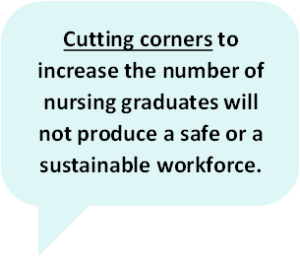
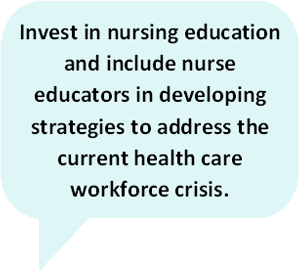 The solution to the problem is not to rush nursing students through their education programs or cut corners to save costs. Nursing education programs are designed to equip students with the knowledge and skills they will need to see this nation through to better health. The public and our governments need to address the working conditions leading to the nursing shortage in the short term and support the long-term solution to the current health care crisis—which has always been a strong educational preparation of practical nurses, registered nurses, and nurse practitioners as well as entry-to-practice support for all new nursing graduates. Investment in nursing education and the inclusion of nurse educators in developing strategies to address the current health care workforce crisis are crucial.
There are several areas in nursing education that offer potential solutions to a sustainable nursing workforce.
- Increase the clinical competence and retention of registered nurse graduates.
- Increase the number of new registered nurses without sacrificing quality.
- Increase the number of internationally educated nurses entering the nursing workforce.
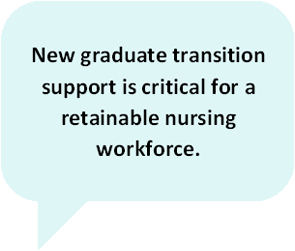 Support new graduate transition.
New graduates require a robust orientation program, a progressive workload, guidance, supervised practice, topical learning workshops, and support for at least 6 months and up to a year. By supporting their transition to practice through residency programs, we can increase the clinical competence and retention of registered nurse graduates.
Increase the number of IENs and cut the red tape.
Through more effective collaboration with schools of nursing and nursing regulatory bodies, we can develop more standardized bridging programs offered by post-secondary institutions, reducing the wait-time required for IENs to transition into practice. This can increase the number of experienced nurses entering the workforce significantly and alleviate nursing shortages.
Increase the number of RNs without sacrificing quality.
Through advanced standing baccalaureate nursing programs for individuals with a degree in another discipline, we can effectively increase the number of new RNs without sacrificing the quality of their education. These programs run throughout the full year (four rather than two terms a year) and are, therefore, normally completed in 2 years without any reduction in the curriculum. There is a high demand for admission into these programs and their graduates typically excel as nurses.
Multiple studies in the United States and in Australia have shown that residency programs increase the safety, clinical competence, and job satisfaction of new graduates, while reducing the employer’s turnover costs (Hansen, 2018).[1]
[1] Hansen, J. (2018). Nurse residency program builder (2nd ed.). HCPro Inc.
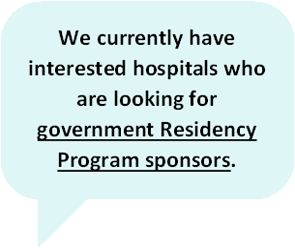 CASN offers a structured, competency-based Residency Program that supports the integration of nursing graduates into the workforce who are competent, emotionally resilient, and retainable. The Residency Program was developed for health care institutions in response to the increasing demands facing new graduates. Program costs are paid by the health institution (the employer) or funded by government partners (fully or partially). There is no cost to nursing graduates. From advanced beginner to competent registered nurse, CASN’s Residency Program is helping reduce nursing shortages by growing a sustainable, retainable nursing workforce with increased capacity and competence. For information about the program, contact CASN’s Jessica Pearce Lamothe.
Quality Nursing Education National Insight
COVID-19 has been filling hospital beds, the numbers of older adults requiring care are increasing, and experienced nurses are leaving the profession in large numbers. Schools of nursing in all provincial/territorial jurisdictions are responding to government demands to increase the number of students admitted to a program, open new sites, and/or offer additional programs. Schools of nursing, however, are already graduating more registered nurses than ever before. The challenge is inadequate funding for faculty, resources, facilities, and support to be able to effectively prepare a record number of new nurses with the knowledge, skills, and resilience needed in today’s workforce. There is an urgent need for investment in high-quality nursing education to support additional seats.
More nurse grads than ever before.
CASN conducts an annual nursing student and faculty survey. The number of new registered nurses (RNs) entering the health care workforce climbed steadily from a low of 4,816 in 2000. In the last 6 years, schools of nursing have been graduating more than 12,000 RNs annually, a higher number than has ever been the case (CASN, 2021).[1]
Educating more students requires additional qualified faculty, experienced clinical instructors, well-equipped simulation labs, good library resources, and adequate and appropriate clinical placement sites. Nursing faculty have been stretched to the limit, and clinical placement sites, which are essential to nursing education, are oversaturated. However, despite increasingly complex health care conditions, applications for admissions to baccalaureate programs of nursing are very high—a testament to the potential tenacity of our future nurses.
 Invest in quality nursing education.
There needs to be an investment in the quality of nursing education—not just in the number of seats. Provinces need to work with schools of nursing to invest more strategically in quality education through funding, resources, and support that will empower schools to fully prepare nursing graduates who are competent, emotionally resilient, and retainable.
Use of nursing students as unregulated health care workers to relieve nursing shortages.
Some provinces are allowing nursing students to serve as unregulated workers in hospitals, either for pay or academic credit, to help alleviate stress on the system.
While they are valuable members of the health care team who may provide health or other care to clients and patients, an unregulated care provider (UCP) is not regulated under the Regulated Health Professions Act (Ryder Wright Blair & Holmes LLP, 2013).[1]
 UCPs are compensated providers who have no legally defined scope of practice or practice standards and there is no regulatory mechanism to monitor quality of service. The responsibility of determining the appropriateness in each UCP client situation rests with supervising nurses and/or employer.
UCP programs done right helps everyone.
Nursing students working as UCPs obtain practical hands-on and observational clinical experience in a health care setting. It is paramount, however, that their clinical practical experiences are not limited to the provision of personal care support.
When done wrong, a UCP program experience provides an extra personal care laborer but results in a nursing graduate who is underprepared for the job. When done right, hospitals gain much-needed nursing support, patients gain the care of better prepared nursing students, and the students gain foundational caring skills and a better understanding of the health service environment.
Quality Nursing Education National Insight
The pandemic caused a 2-year period of repeated curricular disruptions forcing schools to repeatedly shut, open, shut, and reopen, and faculty and students shifted back and forth from in-person to remote learning. This disrupted student access to clinical placements as well as in-person classroom and laboratory learning. Endemic COVID-19 continues to fill hospital beds and experienced nurses have been leaving the profession in large numbers, further impacting clinical learning. The demands on nursing educators and on nursing students since the start of the pandemic have been heavy.
Studies demonstrate that entry-to-practice is highly stressful for new nursing graduates. Studies also show that increased stress among new nursing graduates leads to early departures from the nursing workforce (Boychuk Duchscher & Windey, 2018).[1]
[1] Boychuk Duchscher, J., & Windey, M. (2018). Stages of transition and transition shock. Journal for Nurses in Professional Development, 24(4), 228–232. https://doi.org/10.1097/NND.0000000000000461
 Nursing is a complex and emotionally demanding profession that requires graduates to possess an in-depth theoretical and scientific foundation, strong clinical reasoning skills, solid clinical judgement, honed technical skills, compassion, caring, and emotional resilience.
Support practice-based learning.
Students require robust practice-based learning experiences. Schools of nursing need support to establish more clinical placement and preceptor sites. They also require support to hire clinical instructors, preceptors, mentors, and coaches, and establish well-equipped simulation labs that will allow nursing students access to clinical placements and in-person laboratory learning.
 Living with endemic COVID-19.
As our provinces continue to open up with fluctuating COVID-19 cases, schools of nursing must prepare nursing graduates to support Canadians in the context of endemic COVID-19. Governments must provide support for the long-term solutions to the current health care crisis—and strong educational preparation of practical nurses, registered nurses, and nurse practitioners as well as entry-to-practice support for all new nursing graduates provides a solution.
Quality Nursing Education National Insight
 Collaboration among nursing education, governments, and health care services results in more strategic investments in nursing education; that will help conserve the high quality of nursing education that Canada is known for internationally and help resolve the current nursing shortage.
Schools require additional funding for programs, resources, sites, and faculty, but more than that, they require a seat at the strategic planning table. This will allow them to provide context on the challenges and education on what works and what doesn’t. With effective collaboration, the right support goes to the best solution at the appropriate time.
Schools of nursing need a seat at the table.
Effective collaboration between governments, service, and nursing education is foundational to addressing the current nursing shortage and improving the health of Canadians. We strongly encourage government leaders to reach out to the schools of nursing in their province and invite them to present the challenges they are experiencing and collaborate with them on the development of feasible and effective strategies to overcome them.
Conclusion
Maintaining Canada’s high quality of nursing education is critical to the health and well-being of Canadians. Nursing is a complex and emotionally demanding profession. It requires an in-depth theoretical and scientific foundation, strong clinical reasoning skills, solid clinical judgement, honed technical skills, compassion, caring, and emotional resilience. Nursing incompetence or nursing error can put patients’ lives in jeopardy. Maintaining the high quality of Canadian health care must remain paramount.
CASN and our member schools of nursing are working tirelessly to maintain high-quality nursing education in Canada, and we look forward to strengthening alliances through communication, cooperation, and collaboration on strategies to resolve the current health human resource issues and rejuvenate the health care workforce.
For more information on this resource and how you can support Canadian schools of nursing, please contact us.