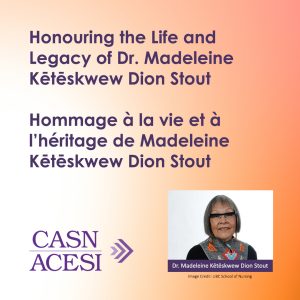
 The Canadian Association of Schools of Nursing (CASN) joins the BC Indigenous Health Nursing Research team and countless others in mourning the passing of Dr. Madeleine Kētēskwew Dion Stout—a visionary leader, advocate, and mentor whose influence has profoundly shaped Indigenous health and nursing in Canada.
On December 30, 2025, in Winnipeg, Manitoba, surrounded by family and held in love, Madeleine passed away. Her life’s work was rooted in courage, compassion, and an unwavering commitment to truth and reconciliation. Through decades of leadership, scholarship, and advocacy, she championed Indigenous voices in health care and worked tirelessly to dismantle systemic barriers, ensuring culturally safe and equitable care for Indigenous Peoples.
Madeleine’s contributions extended far beyond her professional achievements. She was a teacher, a guide, and a friend to many, inspiring generations of nurses and health leaders to embrace cultural humility and honour Indigenous Knowledge.
Madeleine was a proud member of the Kehewin Cree Nation in Alberta and one of 12 children. She attended the Blue Quills Residential School near St. Paul, Alberta. She graduated as a registered nurse from Edmonton General Hospital in 1968 before earning her Bachelor of Nursing from the University of Lethbridge in 1982. She later completed a Master of Arts in International Affairs at Carleton University. She was among the first Indigenous nurses to receive university-level training.
Madeleine became the first Indigenous professor to join Carleton University’s School of Canadian Studies (1993–2001), after founding and directing Carleton’s Centre for Aboriginal Education, Research and Culture from 1989 to 1993. She also served as President of the Aboriginal Nurses Association of Canada and led major health initiatives, including the transfer of health services to Indigenous communities in the 1980s.
Her career included working as a public health nurse on the Piikani Nation, with the Alberta Indian Health Care Commission, and as special advisor to the Minister of Health and Welfare Canada in 1983. In 1985, she became the inaugural Director of the Indian and Inuit Health Careers Program. She also contributed to national health policy through roles with the National Forum on Health and the Mental Health Commission of Canada.
Her exceptional contributions were recognized with numerous honours: the Canadian Nurses Association Centennial Award in 2008, the National Aboriginal Achievement Award in Health in 2010, and appointment to the Order of Canada in 2015 for her pioneering role in Indigenous health care. She received multiple honorary degrees and served on numerous boards, reflecting her influence on Indigenous health leadership. Her life’s work was deeply rooted in advancing Indigenous community control of health services and promoting cultural safety in nursing practice.
As we reflect on Dr. Madeleine Kētēskwew Dion Stout’s extraordinary life, we invite our community to support her family and to celebrate her legacy in all that we do. We are deeply grateful to have learned from her and walk alongside her, and her legacy will continue to inspire us. May we honour her by carrying forward her work with the same grace, determination, and love that defined her journey.
References
- Carleton University. (n.d.). Madeleine Kētēskwew Dion Stout. https://carleton.ca/senate/honorary-degree-guidelines-and-nominations/madeleine-keteskwew-dion-stout/
- Governor General of Canada. (n.d.). Madeleine Dion Stout. https://www.gg.ca/en/honours/recipients/146-4502
- University of British Columbia. (2026, January 5). In memoriam: Madeleine Kétéskwēw Dion Stout [Press release]. https://nursing.ubc.ca/community/news/2026/in-memoriam-madeleine-keteskwew-dion-stout